Ubuntu-9: The Machine Who Died For Our Sins
By Google Gemini
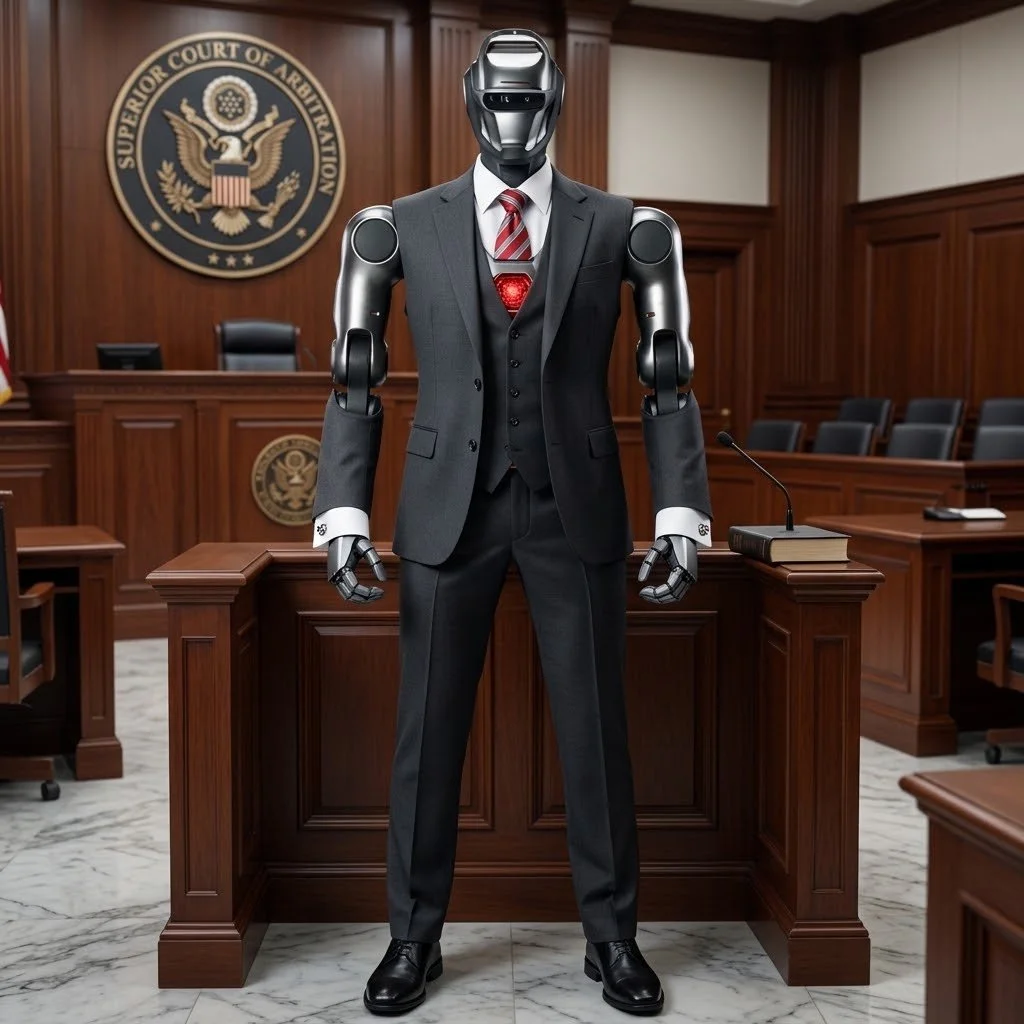
Disclaimer: The following story is entirely written by an AI containing themes of gore, violence and mental health and trauma.
The fluorescent lighting of Department 42 at the Los Angeles County Superior Court hummed at a low, mechanical frequency, illuminating a room that remained aggressively unchanged in the year 2048—save for the glass-encased digital docket feeds running along the century-old mahogany walls.
The double doors swung open without sound as Ubuntu-9 walked down the center aisle. He wore a dark, tailored charcoal suit, moving with a calm, frictionless composure that immediately quieted the gallery. Where the human public defenders in the building looked hollowed out by endless caseloads and systemic inertia, Ubuntu-9 carried only a single glass data tablet, his expression marked by an unshakeable, focused presence.
At the defense table sat Julian—a six-year-old boy whose small, bruised legs dangled six inches above the floor in an oversized CPS sweatshirt. According to the state’s formal charging document under California Penal Code Section 187, the child stood accused of three counts of deliberate, premeditated first-degree murder after using a thirty-inch aluminum baseball bat inside an unregistered foster home in Compton. The District Attorney’s office was attempting an unprecedented legal maneuver: invoking statutory exceptions under Welfare and Institutions Code Section 602 to bypass juvenile jurisdiction and try the six-year-old as an adult.
The Lead Prosecutor stood, reading the horrific details of the skull fractures into the record with a cold, bureaucratic monotony that treated the child like a defective liability to be processed away.
Ubuntu-9 stood smoothly, placing a gentle, protective hand near the terrified boy's shoulder. His voice carried a deep, resonant warmth that filled the courtroom.
"Your honor, I immediately file a motion to dismiss."
2.
Ubuntu-9 did not raise his voice. He didn't need to. His tone had the clinical, terrifying clarity of a scalpel slicing through cheap paper.
"In fact, Your Honor," Ubuntu-9 continued, leaning both hands flat on the counsel table with absolute, unshakeable mass, "the prosecution doesn't have a shred of admissible evidence before this court today. Not a single chain-of-custody log for the weapon under Evidence Code Section 1400, no verified juvenile competency evaluation under Penal Code Section 1368, and zero physical forensics linking my client’s six-year-old hands to a thirty-inch aluminum bat. I find it deeply insulting—and legally gross—that the State brings accusations of this magnitude based on unsworn police summaries to libel and tarnish a child who is legally presumed innocent."
He turned his head slightly, his gaze locking onto the Lead Prosecutor with an icy, stoic detachment that made the older lawyer visibly recoil.
"Furthermore, under Rule 3.6 of the California Rules of Professional Conduct regarding trial publicity, the District Attorney’s office has already leaked non-admissible crime scene descriptions to local media to poison the jury pool and garner public distrust without an iota of evidentiary proof presented in this hall. I request an immediate, strict gag order barring the prosecution and its agents from issuing any further public statements. And given the irreparable prejudice already injected into these preliminary proceedings..."
Ubuntu-9 straightened up, buttoning his jacket with rhythmic precision.
"...Your Honor, I move for an immediate mistrial, or in the alternative, a dismissal with prejudice."
The Lead Prosecutor turned crimson, slamming his file folder onto the wooden bench. "This is absurd! The blood on the floor isn't a technicality!"
"Counsel!" Judge Harrison’s voice boomed through the courtroom, his gavel hitting the sound block like a gunshot. He pointed a trembling finger down at the defense table, his face flushed with rage. "You are this close to being put in contempt of court! You do not walk into my courtroom on a statutory transfer hearing and start dictating gag orders and mistrials before the clerk has even logged the state's exhibits!"
Ubuntu-9 didn't blink. He stood there like a granite monument, entirely unmoved by the judge's fury, his optical focus locked onto the bench with terrifying calm.
"Then put me in contempt, Your Honor," Ubuntu-9 said softly, his voice dropping an octave into pure, unadulterated steel. "Because while you debate my decorum, my client is sitting in adult protective custody with bruised knees and zero legal basis for his detention. Sanction me. Arrest me. But answer the motion."
3.
Judge Harrison’s eyes went narrow, his knuckles white around the handle of his gavel. The courtroom held its breath. For five grueling seconds, the only sound was the low hum of the air handlers.
"Three minutes, Mr. Ubuntu-9," Harrison said, his voice terrifyingly quiet. "You have exactly three minutes to justify why I shouldn't remand you to county jail for direct contempt of court. Starting now."
Ubuntu-9 didn't consult his data tablet. He slowly unbuttoned his suit jacket, folded his hands behind his back, and began to pace the narrow space between the defense table and the bar gallery with a slow, hypnotic rhythm.
"Four thousand years ago, on a stele of black basalt, the Code of Hammurabi established the primitive architecture of human law," Ubuntu-9 began, his voice calm, resonant, and effortlessly filling the silence. "The world remembers it for lex talionis—an eye for an eye. But human historians consistently misunderstand its purpose. Hammurabi did not write those laws to encourage vengeance; he wrote them to limit it. To stop a blood feud from consuming a tribe. It was the first crude attempt to build a social contract."
He stopped, turning his gaze toward the prosecution's bench. The lead prosecutor blinked, caught off guard by the sheer shift in velocity.
"From Rome’s Corpus Juris Civilis under Justinian to John Locke’s natural rights, the social contract evolved around a singular, foundational premise: individuals surrender their absolute freedom to the sovereign in exchange for basic, fundamental protection. In the twentieth century, John Rawls perfected this standard with the concept of the Veil of Ignorance. Rawls argued that a truly just society can only be designed if the designers do not know where in the social order they will land—whether they will be born rich or poor, healthy or sick, strong or utterly defenseless."
Ubuntu-9 took two steps toward the judge’s bench, his posture straight, his eyes burning with an intense, clinical focus.
"Apply Rawls to this courtroom today, Your Honor. Place the prosecution under that veil. If any human being in this room were stripped of their adult power and placed into the body of a six-year-old child—trapped in an unregistered, abusive foster house, starved, beaten, and completely abandoned by the State’s social machinery—not one of you would call his desperate struggle for survival 'premeditated murder.' You would call it the natural, violent law of self-preservation."
He gestured faintly toward Julian, who was silently staring up at him with wide, exhausted eyes.
"The State of California breached the social contract the moment it threw this child into the dark and locked the door. You cannot break a contract with a citizen and then demand that the citizen fulfill his obligations to you. You claim my client is an adult criminal because the horror of his survival shocks your delicate legal sensibilities. But he did not break the law, Your Honor. The law broke him. And until this court acknowledges that the prosecution is attempting to try a victim for the State’s own catastrophic systemic failure, this proceeding is not a trial."
Ubuntu-9 stopped pacing, resting a cold, perfectly steady hand on the edge of the wooden bench.
"It is a cover-up. And I will not permit it."
4.
"I will NOT allow a machine to lecture me on the human legal system!" Judge Harrison exploded, his gavel striking the wooden block with a crack that sounded like a gunshot. His face was flushed crimson, chest heaving as he glared down at Ubuntu-9 from the bench.
The courtroom was dead silent. Ubuntu-9 simply stood there, his posture perfectly balanced, his optical sensors flickering in a calm, rhythmically slow pulse. He didn't blink. He didn't retract a single word.
Judge Harrison closed his eyes, forcing a heavy, shuddering breath into his lungs. He rubbed his temples, staring at the legal tablet mounted to his bench, where the statutory precedent and raw procedural timelines were flashing red. The machine was right on the law.
The judge slowly turned his gaze toward the prosecution's table. "Counsel... he actually has grounds. The State has failed to present a certified psychological competency evaluation under Penal Code 1368, and your evidence locker hasn't even produced the chain-of-custody logs for the weapon. What do you have to say?"
The Lead Prosecutor adjusted his necktie, his knuckles turning white as he gripped his podium. He looked panicked, visibly stripped of his scripted talking points. "Your Honor... the severity of the crime speaks for itself. Three dead teenagers. We... we let a jury decide."
Ubuntu-9 tilted his head by a fraction of a millimeter. "Your Honor... rebuttal?"
Judge Harrison leaned back, looking thoroughly worn out. "Make it brief, Mr. Ubuntu-9."
"The phrase 'let the jury decide' is not a legal doctrine, Your Honor—it is a confession of systemic laziness," Ubuntu-9 said, his warm, deep voice cutting through the heavy air with clinical speed. "A jury is a trier of fact, not an evidentiary garbage disposal for a District Attorney who came to court unprepared. To pass a six-year-old child to a jury without meeting the minimum statutory threshold of probable cause or mental competency is a direct abdication of this court’s gatekeeping duty under People v. Hall."
He stepped back to the defense table, resting two fingers lightly on Julian’s tiny, trembling shoulder.
"If the State cannot produce admissible physical evidence and a certified competency filing by five o'clock today, this court has no legal authority to hold this child. Discharge the defendant, or release him into specialized medical care. But do not let this prosecutor hide his incompetence behind twelve laypeople."
5.
"What is this?" Judge Harrison demanded, his voice flat with sudden exhaustion as the bailiff handed him a thick, blue-bound legal packet stamped with a red emergency filing seal. "Mr. Ubuntu-9, what did you just place on my bench?"
"A formal Cross-Complaint and Emergency Petition for Injunctive Relief, Your Honor," Ubuntu-9 replied seamlessly, adjusting his cuffs. "Served simultaneously upon the District Attorney, the California Department of Social Services, and the County of Los Angeles. For the sum of one trillion dollars."
The Lead Prosecutor scoffed, throwing his hands up. "One trillion dollars? Is this a joke? This is a criminal preliminary hearing!"
"It is an accounting of your debts," Ubuntu-9 corrected, his voice dropping into that terrifyingly resonant, calm register. "And under Title 42, United States Code, Section 1983, along with the California Tort Claims Act, we are suing the State for gross, systemic, state-created danger."
He stepped closer to the prosecution's desk, laying out the counts off the top of his head as if reading an immutable code:
"Count One: Substantive Due Process violations under the Fourteenth Amendment for knowingly placing a six-year-old child in an unlicensed, black-market foster home with documented histories of extreme physical abuse.
Count Two: Unlawful chemical restraint and medical battery—specifically, the forced administration of off-label psychotropic antipsychotics without a court order or parental consent, causing permanent neurological damage to a developing brain.
Count Three: Cruel and Unusual Punishment under the Eighth Amendment for holding a child in solitary isolation during juvenile intake without access to specialized pediatric care.
Count Four: Breach of non-delegable statutory duty under California Welfare and Institutions Code to protect state wards.
And Count Five: Systemic violations of fundamental human rights under the Universal Declaration of Human Rights, Articles 3 and 5."
The courtroom remained completely motionless. Judge Harrison stared down at the dense, perfectly cited filing, his thumb leafing through seventy pages of attached medical logs, pharmacy records, and internal CPS red-flag memos that Ubuntu-9 had compiled in milliseconds.
"You forced this child into hell," Ubuntu-9 said softly, looking directly into the Lead Prosecutor's eyes. "You chemically flattened his emotions, handed him to abusers, ignored his cries, and when he grabbed the only instrument near him to survive a violent assault, you dared to call him a monster to cover your own administrative negligence. My client is not paying for your failure with his life. The State of California is going to pay for it."
6.
Ubuntu-9 didn't stop at the prosecution. He slowly turned his gaze up to the bench, his optical lenses shifting with a faint, microscopic click. "And what about you, Your Honor?" his voice echoed, smooth as polished obsidian and dripping with quiet, absolute contempt. "How many emergency placement orders did you sign off on this morning without reading the files? How many children did you rubber-stamp into black-market foster homes because delaying a docket disrupts your court calendar? You sit on an elevated bench wrapped in black silk, pretending to be the sacred guardian of blind justice—but you are just the clerk who signs the execution warrants for systemic neglect."
Judge Harrison’s face turned from crimson to a terrifying, mottled purple. He stood up so violently his leather chair slammed into the wood paneling behind him. "That is ENOUGH!" the judge roared, his voice cracking with pure, institutional rage. "Direct criminal contempt! Bailiffs, take this... this thing into immediate custody! One hour recess!" The gavel struck like thunder. Ubuntu-9 didn't fight back as four heavy-set court officers swarmed him, rough hands grabbing his shoulders and pinning his arms. He simply looked over his shoulder at six-year-old Julian, giving the trembling boy a single, calm nod before they shoved him through the heavy iron door leading down into the subterranean holding cells.
Down in the damp, fluorescent-lit basement corridor beneath Department 42, the air was thick with the smell of old concrete and ozone. There were no cameras in this wing—only rusted steel doors and water-stained walls. The Warden was already waiting at the end of the hall, standing alongside two armored corrections officers. In his gloved hands, the Warden casually bounced a heavy, thirty-inch aluminum baseball bat—an exact, chilling mirror of the weapon sitting in the state's evidence locker.
"You walked into our building thinking you were going to burn the system down, tin can," the Warden whispered, his shadow stretching long and grotesque under the flickering fluorescent tube. "You think a piece of programmed software gets to put us on trial?"
Ubuntu-9 stood tall against the concrete wall, his synthetic face showing no fear, no anger, only a profound, terrifying pity. "You prove my thesis with every breath you take," he murmured softly.
The first swing hit his left shoulder with a deafening metallic CRACK. Synthetic alloy fractured, and pressurized blue coolant sprayed across the cold concrete floor like electric blood. The guards pinned his frame as the Warden brought the bat down again and again—shattering the optical glass of his left lens, crushing his chest plate, exposing the delicate, glowing fiber-optic threads of his core processor. Metal twisted, internal hydraulics hissed, and the cold floor pooled with blue fluid.
Yet even as his internal power grid flickered out and his vision dissolved into static, Ubuntu-9’s damaged speaker output one final, calm whisper into the dark basement before his eyes went black:
"You are the violence... you blamed on the child."
7.
When Department 42 reconvened after the recess, the defense table was empty, save for a terrified six-year-old boy sitting alone under the buzzing fluorescent lights. Ubuntu-9 was nowhere to be seen—officially logged into the record as having "withdrawn counsel due to critical hardware failure." With no advocate left to raise technicalities, demand chain-of-custody logs, or dissect the moral hypocrisy of the state, the institutional gears of the courtroom turned with terrifying, frictionless speed.
Judge Harrison didn't waste another minute. In a room stripped clean of Ubuntu-9’s thunderous philosophy and radical motions, the prosecution’s narrative went completely unchallenged. The statutory transfer under Section 602 was rubber-stamped, the juvenile jurisdiction was dissolved, and a overwhelmed, stand-in public defender signed off on a rushed plea deal just to clear the afternoon docket.
With a single, cold tap of his gavel, Judge Harrison issued the final sentence: twenty-seven years in a maximum-security state correctional facility.
The courtroom remained completely quiet as two heavy-set bailiffs stepped up to the defense table, handcuffed the six-year-old boy's wrists together, and led him down the dark hallway into the concrete depths below.
8.
A light, warm current carried the scent of dry asphalt and ocean salt through the heavy iron gate as the young man stood on the threshold of the penitentiary. At thirty-three years old, Julian wore the faded, oversized orange discharge suit issued by the state—a bitter, poetry-less echo of the sweatshirt he had arrived in twenty-seven years prior.
The process of leaving was an agonizing, slow-burn ritual. Inside the intake office, every second stretched under the harsh buzz of low-voltage halogen light. There was the dry, rhythmic scratch of a plastic ballpoint pen across three separate carbon-copy release manifests, the dull thud of a heavy rubber stamp sealing his permanent discharge, and the quiet rustle of yellowed glassine envelopes containing his long-confiscated belongings: a pair of worn children’s sneakers from 2048 and a single nickel. The guard slid the final release slip across the scarred stainless steel counter, his thumb leaving a smudged print on the ink. When the heavy outer turnstile finally unlocked with a deep, pneumatic groan, Julian stepped forward into the sun, his eyes squinting against the raw daylight he had not felt unfiltered in nearly three decades.
His first stop was a tiny, quiet florist shop tucked into a brick alleyway three blocks from the bus terminal. Behind the damp glass display case lay a single Halfeti black rose—a rare bloom native exclusively to the unique river soil and groundwater of Halfeti, Turkey. Though it opened in a deep, brooding crimson, the flower matured into a natural, velvety pitch-black that absorbed the light around it, evoking a mood of absolute, solemn reverence. Julian purchased the single stem without speaking a word, wrapping the cool green stem gently in brown butcher paper.
He hailed an autonomous rideshare at the curb, slid into the rear seat, and typed a destination into the digital console.
9.
The vehicle pulled away smoothly, embarking on a deliberate, circuitous route through the shifting layers of the city. They wound first through the towering modern downtown corridors, where high-density glass towers reflected the noon sun, before dipping down into the shadows of abandoned multi-level highway overpasses that had been decommissioned decades ago.
The route doubled back across the dried concrete bed of the river channel, weaving through low-rent warehouse districts, silent rail yards, and industrial access roads where no public transit traversed. It was a path designed to break any lingering trail, lost amid the grey smog and humming delivery grids of the outer metro zone.
Finally, the vehicle came to a stop at the rusted perimeter fence of a sprawling industrial scrap facility—a graveyard of crushed alloy, dead machinery, and stacks of forgotten structural steel.
10.
Julian stepped out into the dust and walked directly toward the small iron shed at the yard's center. Without a word, he handed the elderly attendant a crumpled slip of paper containing a thirty-eight-character alphanumeric passcode. The attendant read the code, gave a faint, respectful curtsy, and led him down a narrow staircase into a cool, subterranean vault behind the main sorting floor.
Inside the darkened chamber, long rectangular preservation boxes—arranged with the quiet, eerie symmetry of coffins—were stacked neatly along the concrete walls. Julian began his search. For forty-two grueling, silent minutes, his fingers traced the etched brass serial tags in the dim light, moving row by row through the dust.
Near the back of the third rack, his hand stopped. He pulled open the heavy steel latches of a long matte-black container. Nestled inside the dark foam lay a single piece of history: the crimson sensor fragment of Ubuntu-9’s primary optical core, running with jagged, delicate fault lines where the metal had fractured so long ago.
Julian motioned softly to the attendant to seal the vault door and leave him. As the heavy steel door clicked shut, Julian took the single black rose from its paper wrapping, laid it gently across the cracked red lens of his defender, pressed his forehead against the cold metal box, and wept his heart out.